With some speaker systems quoting power levels well over 100W, the question you should really ask yourself is how does that power level equate to what my ears will hear? Speakers that require lots of power usually do so because the acoustic drivers they use aren't very sensitive. That means they need more power to produce the same output that a more sensitive driver would need. As a general rule, the smaller the speaker system, the less sensitive any acoustic drivers incorporated into it will be. It becomes far more complicated to achieve higher sound pressure levels from smaller components without introducing distortion.
The output power of a speaker isn't really reflective of how loud it can get. For this, you also need to know the speaker sensitivity and understand what the power rating is measured in. We discussed this in our blog The loudness of music through speakers. Some speaker manufacturers quote output as peek, some as RMS and some as a theoretical maximum. Don't be too concerned about power output. Listen to speakers instead to understand how loud they can get.
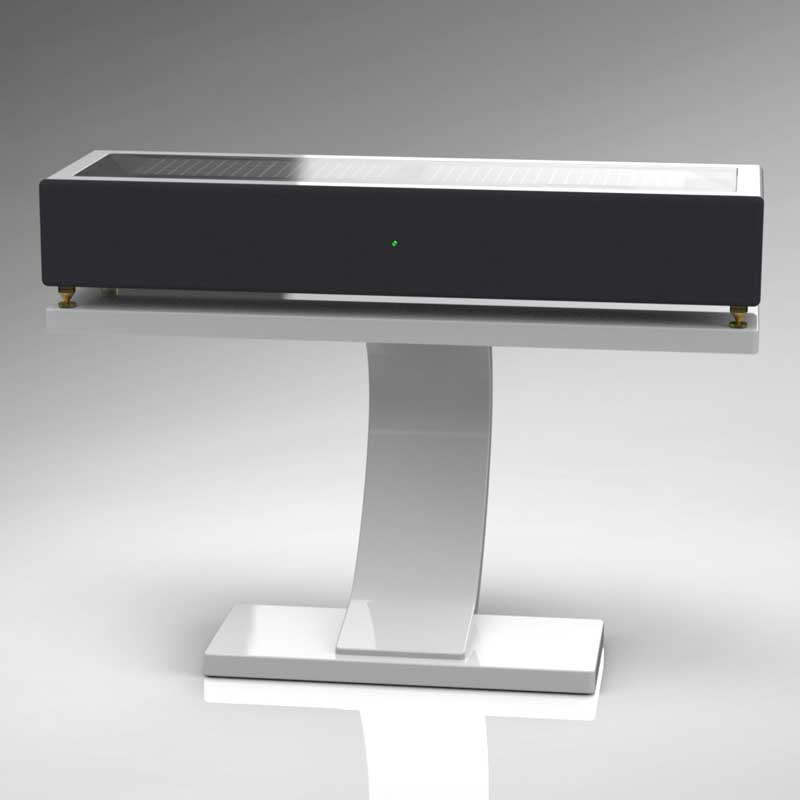
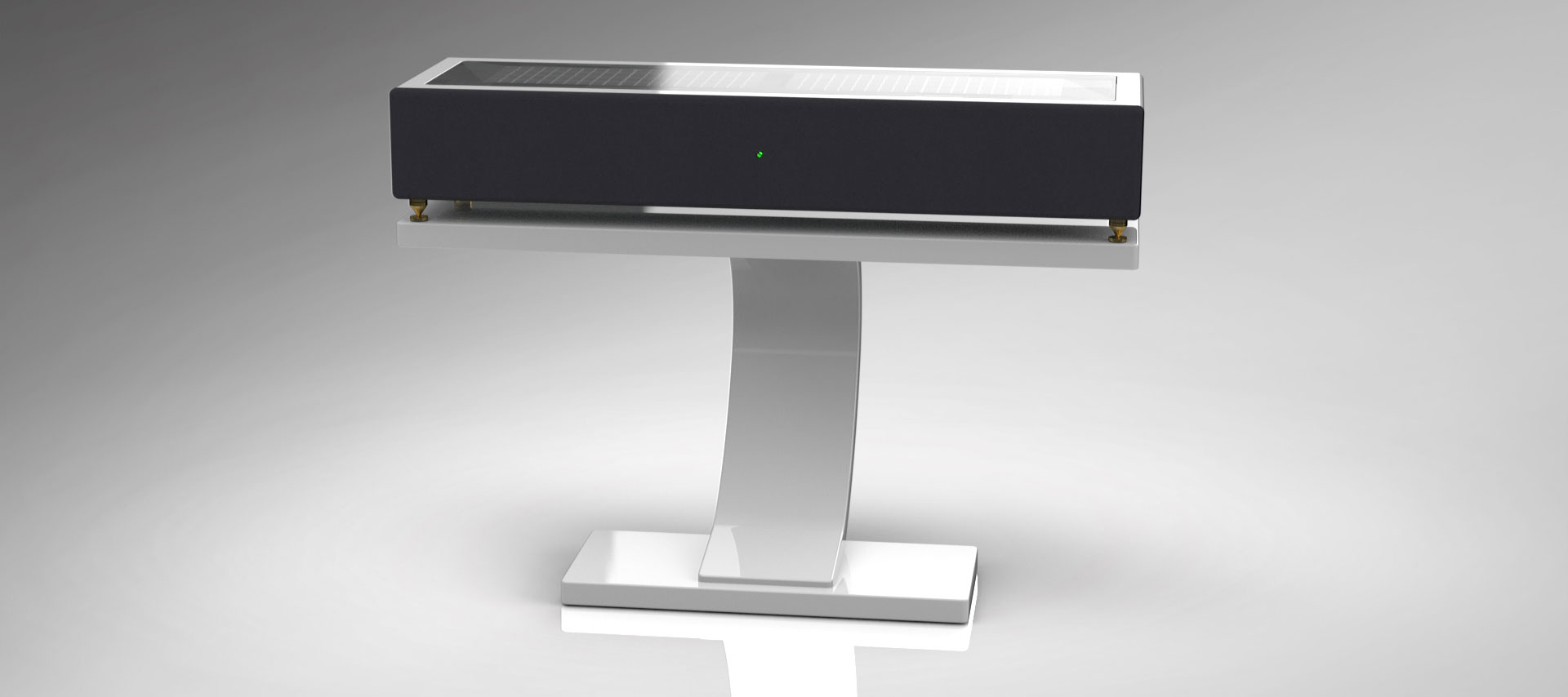
You can deliver 100W into a speaker system that's pretty cheap and nasty and get the same sound output intensity as a top-quality speaker system driven with around 10W of power or less. It all depends on the design of the system. The Bass Clef has been designed with efficiency in mind. There isn't an ample amount of power available for a wireless system, so every bit of power that is utilised is done so very carefully.

Lower cost speaker systems tend to have lower bass response unless the bass is boosted. Boosting the bass requires more power at lower frequencies. There are many techniques used to do this. Some speaker systems enhance the bass response through a tone control circuit that boosts specific bass frequencies. Other speaker systems will utilise mechanical systems in the enclosure to increase bass response. But too much bass can result in distortion. Some distortion is easily noticed, and some isn't. If the bass enhancement is done correctly, the distortion is more to do with how the sound has changed from when it was recorded. Noticeable bass distortion usually occurs when certain frequencies can't be reproduced accurately, and the result is vibration rather than a bass note. Acoustic drivers themselves will distort the sound as will resonances from items in the room that vibrate at specific frequencies. Good bass quality isn't about the loudness of the bass. It's about the range of bass that's available and how linear that range is, matched with the rest of the audio spectrum.
The Bass Clef does not boost or enhance any bass frequencies, keeping the entire audio range as linear as possible. The resulting sound is crisp and clean, with a nice tight but not overbearing bass sound. In a modest-sized room of rectangular size, the bass response from the Bass Clef is strong without producing too much of it that is absorbed into the room itself. That's a significant issue with bass enhancement - the absorption of all that power in the structure of the room or items within it. If the floor starts to shake or vibrate, or the walls do, then a lot of the power being produced is being used to do this. It's wasted power. Bass response does not need to be that intense. It's unnatural and not as the music was originally intended.
The quality of the music put through the system is also of paramount importance. For the best sound quality, always listen to music with a high bit rate.
At a concert, very large, high sensitivity speakers are used to reproduce music. That's because a lot of power is needed to deliver all that sound across a large area and usually open space where sound just dissipates into the air. The speakers at a concert are tuned for particular instruments and the power utilised is significantly higher than that of a domestic speaker system. But what a lot of concert speakers can't do is reproduce an entire spectrum of sound as accurately as a top-end speaker system. It's more a case of power versus audio range and quality. When you sit back in your armchair to listen to music, you don't need to hear it at an intense level. What you do want to hear are all the notes in the music, all the harmonics. If you crank up the bass, then a lot of that is just lost and you may as well be at a concert. The Bass Clef does not have any tone adjustment, relying instead on the music you feed it and the clever enclosure design. The bass it produces is rich, deep and very crisp, handling frequencies down to 30Hz.
Low frequencies are a result of large air pressure changes. A lot larger items in a room resonate at low frequencies and will tend to vibrate when bass is played intensely. You can even feel certain bass notes in your body because your body mass resonates with the sound. The bass response from the Bass Clef begins to drop very quickly below 30Hz, which is reaching the limits of the human ear. Beyond this are sub-bass frequencies (30Hz or lower) that produce more vibration than sound. Some sub-woofers can produce vibrations as low as 10Hz, which no human ear can hear, but the body can feel. Sub-bass frequencies can add realism to certain activities like watching a movie where an explosion can literally knock you out of your seat, your neighbours too. But listening to music doesn't require frequencies this low. The majority of domestic speaker systems are designed to produce sounds above 40-50Hz, which is a very deep audible bass.