
You can have the best audio system available, but none of that matters if your speakers aren't up to the job. A good speaker system will ensure the sound you hear is free of distortion and has good frequency response. People often confuse the term 'speaker' with an acoustic driver. The term 'speaker' should refer to a system that produces sound and not the individual components that make up the system. The elements that actually produce the sound are acoustic drivers (sometimes referred to as speaker drivers or loudspeakers).
Sound is created when air vibrates through pressure changes. This creates an 'acoustic wave'. Our ears can detect these waves as they oscillate from around 20 cycles per second (20Hz) to over 15,000 cycles per second (15kHz).
Bass is produced in the lower spectrum of that range from 20Hz to around 200Hz. At those frequencies, a lot of energy is needed to create changes in air pressure as the air mass being shifted large.
A woofer, pictured below, is a type of acoustic driver that is designed to shift more substantial volumes of air to produce bass frequencies.
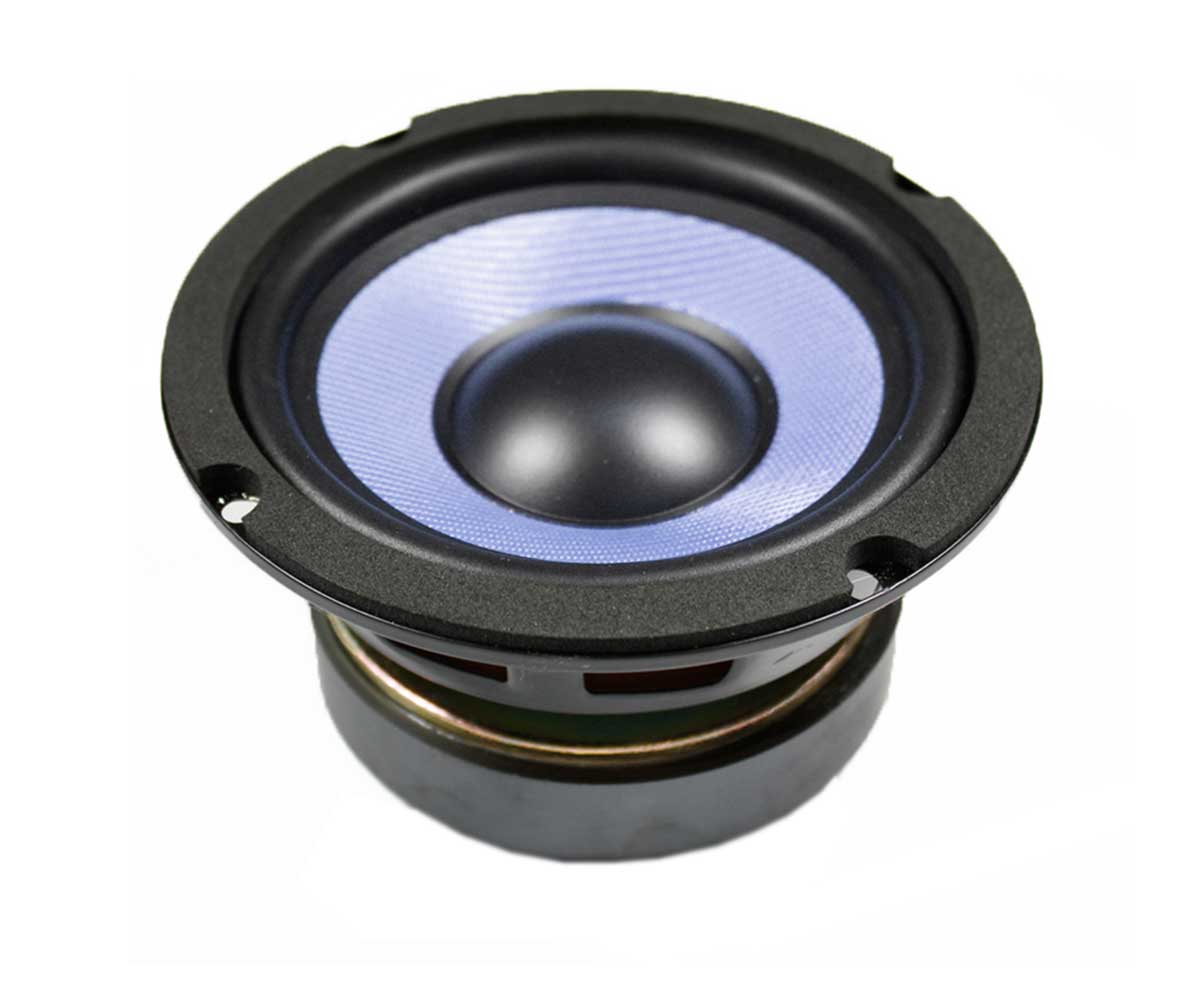
fig.1 - A typical woofer used to produce bass frequencies
Mid-range frequencies are from around 200Hz to 2000Hz (or 2kHz). At those frequencies, less energy is needed to create changes in air pressure as the air mass being shifted is smaller. A mid-range acoustic driver is usually used to produce sounds like this. These drivers look similar to a woofer but have stiffer cones and a higher resonant frequency – that's the natural frequency at which the speaker cone will oscillate at a peak. An explanation of how acoustic drivers work will be mentioned later.

fig.2 - A typical tweeter used to produce high frequencies
High frequencies are those sounds that are often piercing to the ears and are any frequency above 2000Hz (or 2kHz). At higher frequencies, the air mass being shifted is very small, so less energy is needed. As a result, high-frequency acoustic drivers tend to be more compact and lighter than all the others. A 'tweeter' as they are commonly called (pictured above) is used to produce these sounds.
An acoustic driver makes the air oscillate at a particular frequency. The most common way it does this is by pushing or pulling the air using a 'cone' (fig. 3a). The cone can be made up of different materials, but it is usually made of paper, plastic or compressed fibre. The cone needs to be lightweight but stiff. As As the cone moves backwards and forwards from its centre position, any air in front and behind it will also move. If this air movement is at an audio frequency, it will be translated into a vibration that our ears can detect as sound.

fig. 3 - A simplified cross-section of a typical acoustic/speaker driver
Inside most acoustic drivers is a strong permanent magnet (fig. 3g). When an audio amplifier sends a sound signal to the driver, it energises the voice coil (fig. 3e) which creates a magnetic field. Depending on the polarity of the signal, the magnetic field is either attracted to the permanent magnet or repelling from it, resulting in the movement of the cone backwards or forwards.
To support the cone, but allow it to move axially to the magnet, a flexible cone surround is used (fig. 3b). The voice coil (fig. 3e) needs to be accurately centred around the middle of the permanent magnet (fig. 3g), and it is supported there with a coil support structure usually made of a corrugated woven fabric layer (fig. 3f). This ensures it is always concentric to the permanent magnet, but it can move axially.
The materials used to construct the acoustic drivers, the component sizes, tolerances, and manufacturing processes, will determine what frequencies the driver can produce. It is important to understand that all acoustic drivers produce different sounds. As mentioned previously, some drivers are great at producing bass frequencies while others are better at producing high pitch sound.
Because speaker systems need to produce a range of frequencies, and air mass varies through the audio spectrum, the sound they produce isn't entirely linear. There are lots of fluctuations depending on the driver design, the speaker enclosure and the room they are in. What most speaker systems try to do is give the user an optimum range of sound throughout the audio spectrum. In effect, each speaker system has a sound 'signature'. This is why some speakers sound better than others to different people.
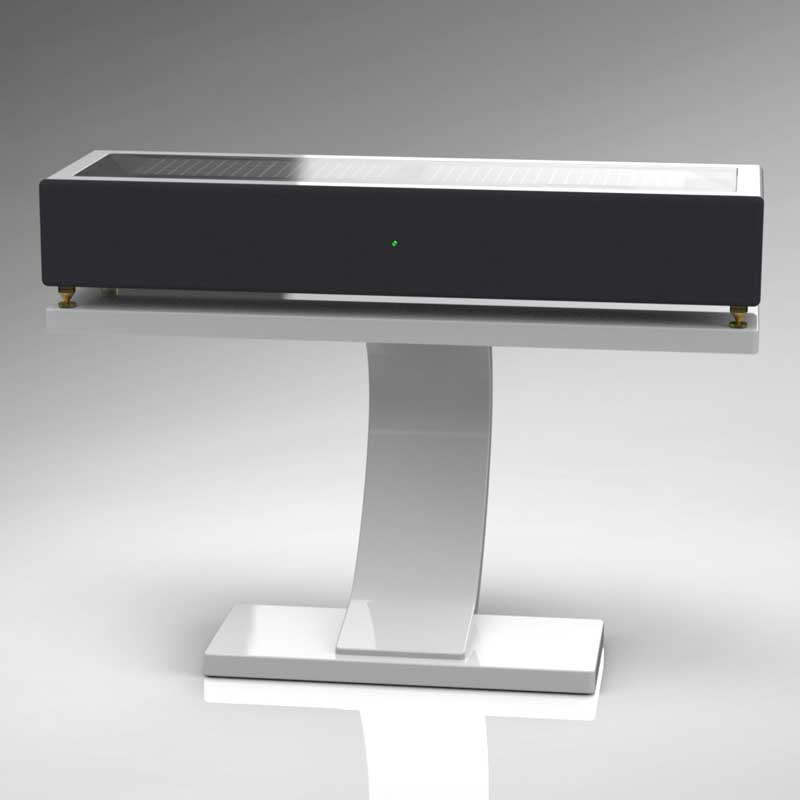
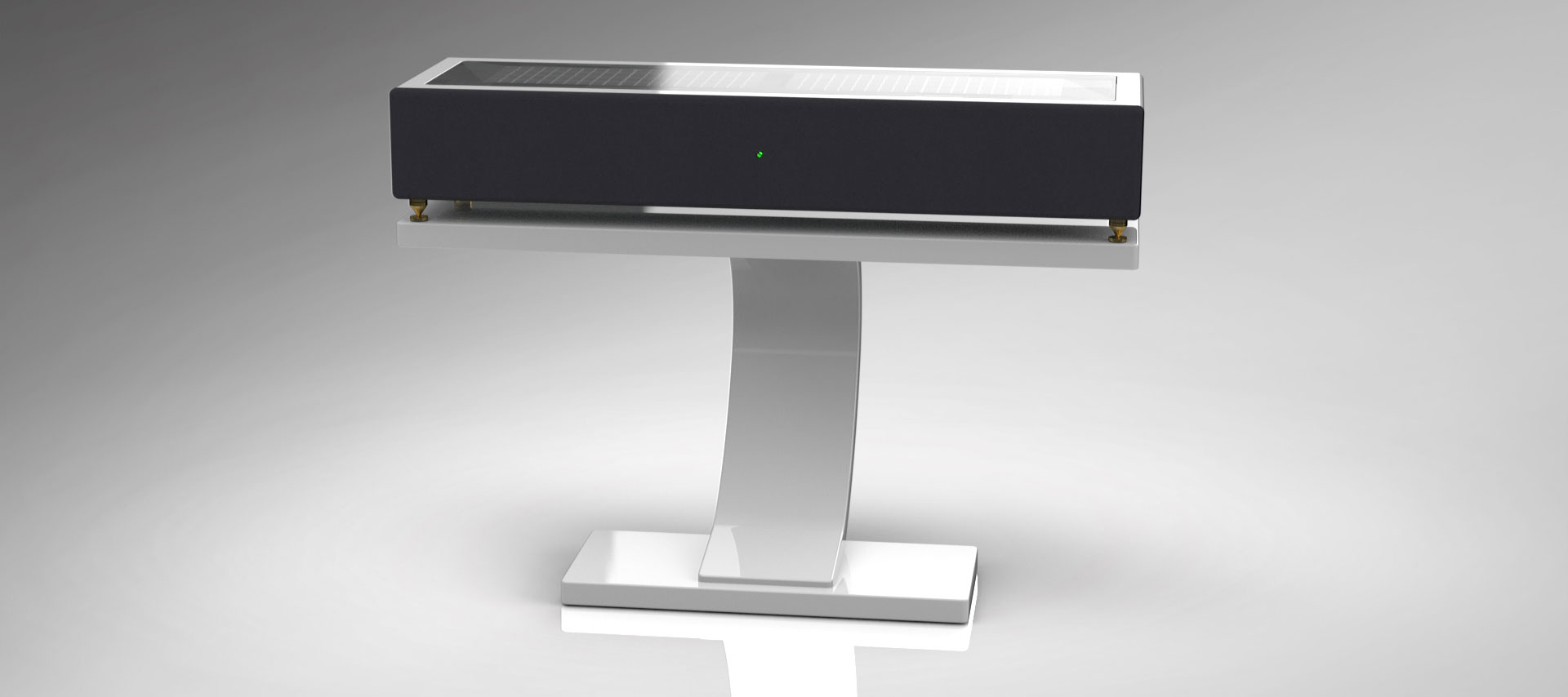
We have spent a long time developing a top-class speaker system that can produce a sound output that is as linear as possible. The Bass Clef has gone through several design iterations to perfect the sound from such a compact unit.
Speaker design is a complex operation. There are many considerations with so many factors that affect the overall sound quality. The main things to consider are:-
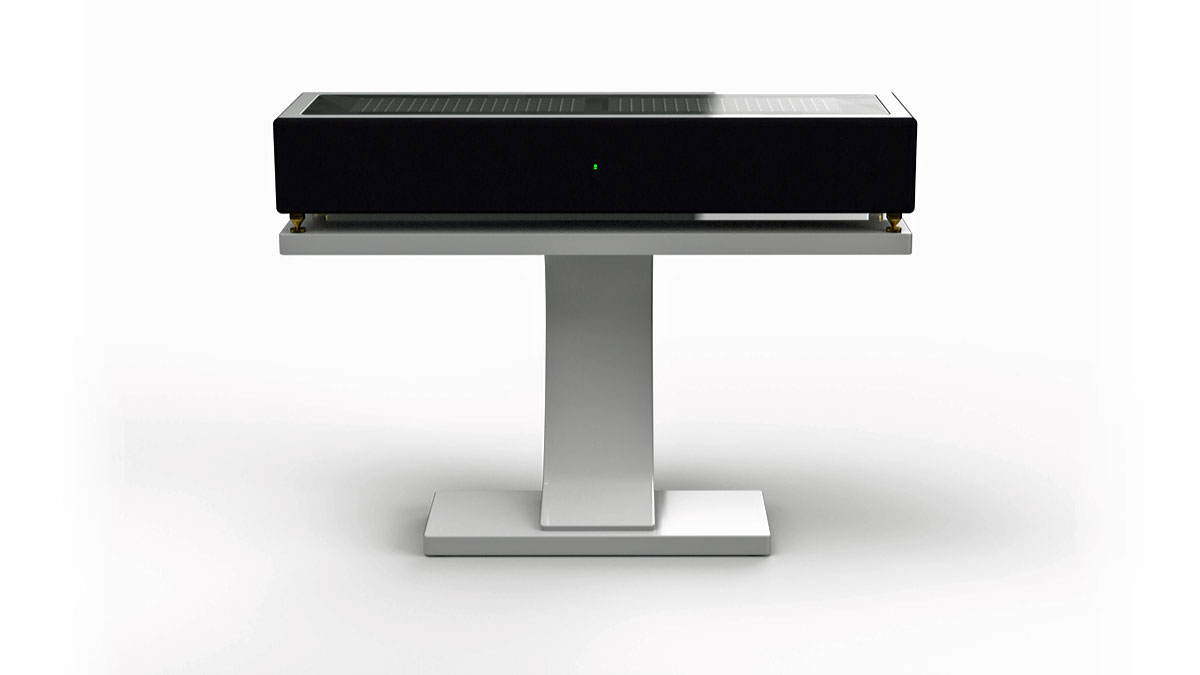
fig. 4 - The Bass Clef and its signature stand
Sound is directed to our ears and straight through to our auditory canals. When a speaker has multiple acoustic drivers, as most tend to do to ensure they provide a good range of sound, our ears can often get confused with where particular frequencies are coming from. This is because some frequencies will result in interference where stray sound signals or certain harmonics create sound distortion. To avoid this, the best practice is to use a single point source sound. This is sound produced from one point, or one driver only. It's difficult to achieve, but we have spent a lot of time researching the best acoustic drivers that can do this. The Bass Clef uses this principle.
Speaker systems that have more than one acoustic driver will usually require a device called a crossover network to filter the signal. A crossover network stops certain acoustic drivers from producing the same sounds as other drivers in the speaker unit, which usually results in distortion as similar sound waves cancel or exaggerate particular sounds.
Crossover networks contain a series of electronic filters to stop specific sound frequencies from reaching a particular driver. A low pass filter only allows low-frequency signals to pass. A high pass filter only allows high-frequency signals to pass. Of course there are lots of filters in between depending on the complexity of the speaker system.
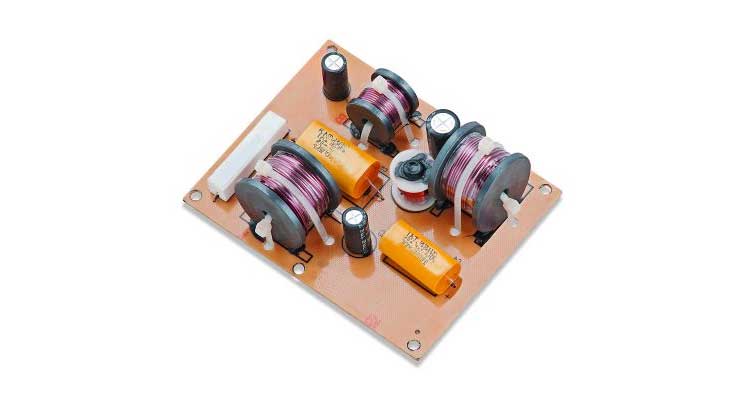
A basic crossover network circuit fitted inside a speaker cabinet
Crossover networks can solve a lot of issues, but they can also create others. The audio signal is being artificially manipulated which can result in distortion. The cut-off points of each filter in the crossover isn't precise either, so there is often a range of frequencies where sound is distorted again. The elimination of a crossover network is the ideal solution, and this can only really be achieved where a single point source acoustic driver is being used.
The enclosure design of a speaker system effectively tunes the sound. The materials used in the construction of the enclosure are critical as is the craftsmanship. The size and shape can also affect the sound as panels resonate at particular frequencies, causing distortion. A general rule is the stiffer the enclosure panel, the better. But there needs to be a balance between practicality, manufacturability and weight. Concrete is an excellent material for speaker enclosures, but it's impractical in reality as it would make speaker units weigh far more than they already do, unless the speakers are small.
Music can sound different from the same set of speakers in different rooms. The size and layout of a room affect sound quality. When sound is produced, it bounces or reflects off walls, floor and ceiling. When it does this, the sound waves can either cancel other sound waves being produced by the speaker or emphasise them. The result is distortion. Square rooms, in particular, are problematic because the sound waves reflect equally in every direction. Objects within the room can also affect the sound by absorbing it or reflecting it as a wall would. The construction of the building creates resonances. Cavity walls and ceilings, in particular, can oscillate at specific frequencies producing sound waves of their own that cancel those from the speaker.
Lastly, if the music you send to the speaker is inferior in quality, it stands to reason that the sound won't be great. The signal needs to be perfect for speakers to reproduce it as it was intended. The Bass Clef has been designed for digital music, and it's always better to feed it music that has a high bit rate.